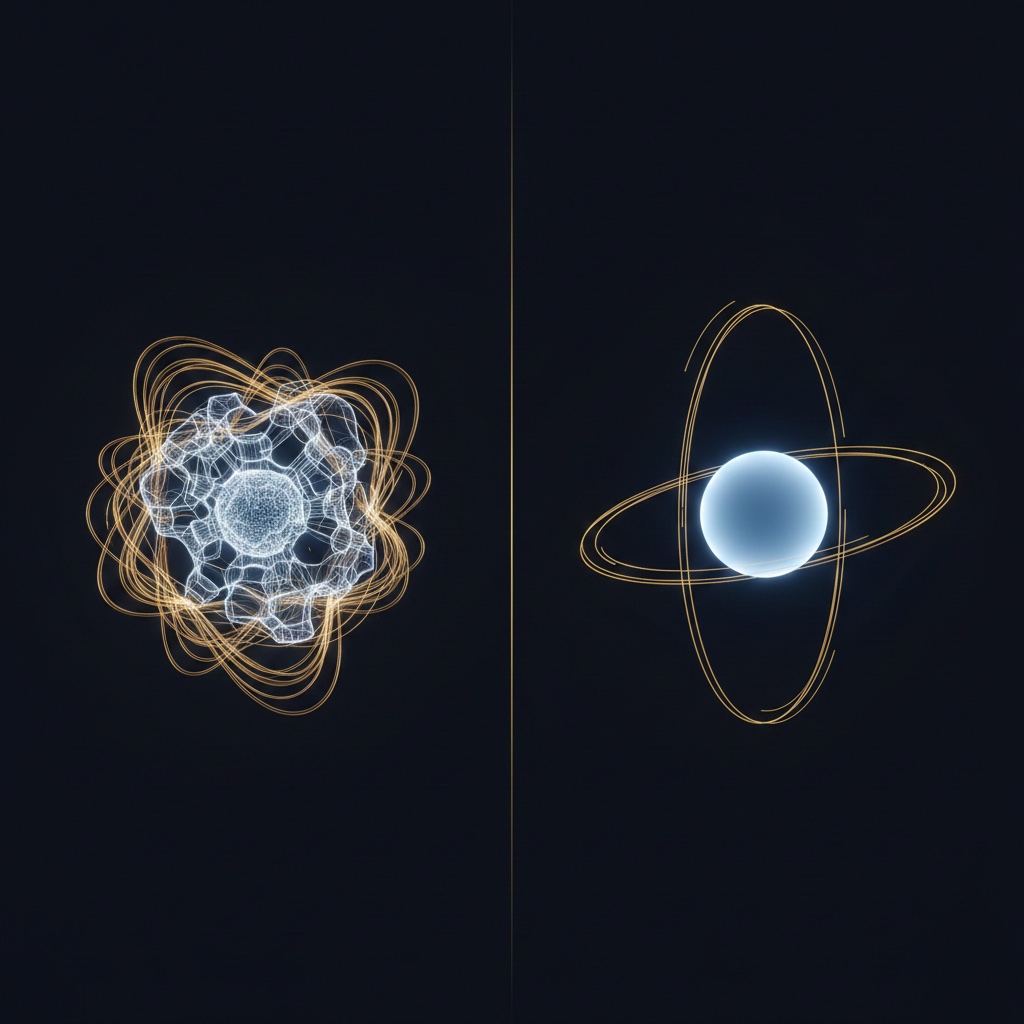
The previous entry presented a number. PSR J1734−3333. Braking index: $0.9 \pm 0.2$. Consistent with a friction — a drag proportional to angular velocity — applied by the vacuum itself.
If you have been reading carefully, you should have an objection. It is the first objection anyone should raise, and it is serious:
This is the right question. It deserves a real answer — not a hand-wave, not an appeal to smallness, but a structural explanation that follows from the mathematics. This entry provides one.
I. Spin Is Not Orbit
First, a disambiguation. The braking index of a pulsar measures the deceleration of its spin — the neutron star rotating on its own axis. It says nothing about the pulsar's orbit around anything.
A pulsar that slows its spin does not fall out of the sky. A figure skater who stops spinning does not stop gliding across the ice. These are different degrees of freedom, governed by different physics.
The question "why does Earth still orbit?" is therefore really two questions: why doesn't the vacuum slow Earth's orbital motion around the Sun, and why doesn't it slow Earth's rotation on its axis? Both have answers. They are different answers.
II. What the Vacuum Monitors
In the Bath-TT framework, the vacuum of a large-$N$ thermal quantum field theory continuously monitors a specific quantity: the transverse-traceless projection of the stress-energy tensor, written $T^{TT}_{ij}$.
This is not an arbitrary choice. The TT projection isolates the degrees of freedom that carry gravitational information — the shape-changing modes. These are exactly the components that generate gravitational waves in linearised general relativity. The vacuum watches the part of the stress-energy that would radiate.
Not everything radiates. The TT projection annihilates certain configurations entirely:
Invisible to TTT
A perfectly spherical mass distribution. Its quadrupole moment $Q_2 = 0$. No matter how fast it spins, $T^{TT}$ does not vary in time. The vacuum cannot see it.
Visible to TTT
An aspherical body — a dumbbell, a neutron star with a magnetic mountain, anything with $Q_2 \neq 0$. When it rotates, $T^{TT}$ oscillates at the spin frequency. The vacuum watches.
This is the first key to the hierarchy. Not all bodies are equally visible to the vacuum. A sphere is invisible. A dumbbell is maximally visible. Everything else falls between, proportional to $Q_2^2$.
III. Two Faces of One Equation
The starting assumption of the framework is that matter is not a closed system. It is coupled to the vacuum — specifically, to a large-$N$ thermal quantum field theory whose internal degrees of freedom we do not observe. We see matter. We do not see the Bath.
When you trace out degrees of freedom you cannot observe, the standard formalism of open quantum systems gives you the Lindblad master equation. This is not a choice or an interpretation. It is the most general Markovian, trace-preserving, completely positive evolution for a quantum system coupled to an environment. It takes the form:
Two terms. Two effects. Both emerge from the same coupling between matter and Bath.
There is a theorem in quantum information theory due to Wiseman and Milburn (1993): any dynamics of the Lindblad form is mathematically equivalent to a continuous weak measurement of the monitored variable, conditioned on a feedback Hamiltonian. This is not a physical interpretation — it is a mathematical identity. The Lindblad equation can always be decomposed into measurement plus feedback.
So the vacuum monitors $T^{TT}$. The question becomes: what feedback Hamiltonian does this monitoring force? Impose four constraints — locality, no-signalling, universality (couples only to stress-energy), and statistical energy conservation — and the answer is unique:
The Coherent Part
The feedback Hamiltonian, fixed uniquely by the four constraints:
$H_{\text{fb}} = -G\!\displaystyle\int \!\!\int \frac{T^{TT}_{ij}(\mathbf{x})\;T^{TT}_{ij}(\mathbf{x}')}{|\mathbf{x} - \mathbf{x}'|}\;d^3x\;d^3x'$
This is Newtonian gravity.
The Incoherent Part
The double commutator — the Lindblad dissipator. It destroys quantum coherences (decoherence) and extracts energy from the system (dissipation). It is the noise floor of the monitoring process.
This is the friction.
Newton's constant is not a free parameter in this framework. It is determined by the monitoring rate $\lambda$ and the number of Bath modes $N$:
The insight is structural: you cannot have gravity without the friction. They are two faces of one equation. The coherent part — the feedback Hamiltonian — produces the gravitational attraction that holds planets in orbit. The incoherent part — the dissipator — produces the decoherence and drag that slow neutron star spin. Both originate from the same Lindblad channel, the same monitoring rate $\lambda$, the same coupling to $T^{TT}$. Remove the friction and you remove gravity.
But their relative magnitudes are not equal. For every system in ordinary astrophysics, the coherent part — gravity — utterly dominates. The friction is real, it is always present, and it is negligible.
IV. Why the Friction Goes as $\Omega$
The friction torque on a spinning aspherical body is proportional to the angular velocity — not its square, not its cube. Proportional to $\Omega$ itself. This is why the braking index is 1 and not some other number. The reason is straightforward.
The Lindblad dissipator is bilinear in $T^{TT}$. For a body with non-axisymmetric quadrupole moment $Q_2$ spinning at angular frequency $\Omega$, the time-varying part of $T^{TT}$ oscillates with amplitude proportional to $Q_2$ and frequency $\Omega$. The dissipated power — energy lost per unit time — goes as the square of the amplitude times the frequency:
The torque is power divided by angular velocity:
Linear drag. The same structure as viscous friction in a fluid. Not because the vacuum is a fluid, but because continuous linear monitoring of a variable produces a damping force proportional to the rate of change of that variable. This is a theorem of open quantum systems, not an analogy.
The braking index follows immediately. If $\dot{\Omega} = -B\Omega$ for some constant $B$, then $n \equiv \Omega\ddot{\Omega}/\dot{\Omega}^2 = 1$.
V. Earth's Orbit
Now to the question. Why does Earth still orbit the Sun?
The answer has two layers.
First layer: the orbit exists because of the Bath. The gravitational attraction keeping Earth on its elliptical path is not separate from the vacuum monitoring — it is the vacuum monitoring. The coherent part of the Lindblad channel, the feedback Hamiltonian $H_{\text{fb}}$, produces Newton's inverse-square law. Earth orbits because the vacuum watches. Asking why the vacuum doesn't stop the orbit is like asking why a river's current doesn't stop the riverbed from existing. The current is the river.
Second layer: the orbit does lose energy. The Earth-Sun system has a time-varying mass quadrupole (Earth is a point mass orbiting another). This radiates gravitational waves. The power radiated is given by the Peters formula, a standard result of general relativity:
Two hundred watts. A pair of incandescent light bulbs. Against an orbital kinetic energy of $\sim 2.7 \times 10^{33}$ joules. The timescale for the orbit to decay:
Thirty trillion times the current age of the universe. This is not a Bath-TT prediction — it is a standard prediction of general relativity, confirmed to 0.2% precision by the Hulse-Taylor binary pulsar. Bath-TT reproduces it: the gravitational wave emission from orbits is the incoherent dissipation of the Lindblad channel applied to orbital motion.
There is no anomalous extra friction on orbits. The energy loss is exactly what GR predicts, and it is negligible.
VI. Earth's Spin
What about Earth's rotation on its axis? Does the vacuum friction slow it down?
In principle, yes. In practice, the effect is buried under twenty orders of magnitude of irrelevance. Here is why.
The friction torque depends on three quantities: the non-axisymmetric quadrupole moment (how far the body deviates from axial symmetry about its spin axis), the spin rate, and the coupling strength (which scales with compactness, $GM/Rc^2$).
Earth is an oblate spheroid — it bulges at the equator by about $1/298$ of its radius. But this bulge is axisymmetric: symmetric around the spin axis. An oblate body spinning around its symmetry axis has constant $T^{TT}$. The vacuum sees no time variation. No time variation, no friction.
The non-axisymmetric part of Earth's shape — the part that is not symmetric about the spin axis — comes from tidal bulges, continental mass distributions, and internal inhomogeneities. These give a non-axisymmetric ellipticity of order $\varepsilon_{\text{na}} \sim 10^{-5}$. This is what the vacuum can see. It is small.
Earth's spin rate is $\Omega_\oplus \approx 7.3 \times 10^{-5}$ rad/s. Earth's gravitational compactness is $GM_\oplus / R_\oplus c^2 \approx 7 \times 10^{-10}$. Compare this to a neutron star.
Meanwhile, the known spin-down mechanism for Earth is tidal friction from the Moon. The Moon raises tides, the tides dissipate energy, and Earth's rotation slows by about 2.3 milliseconds per century. The power dissipated: roughly 3.3 terawatts. The vacuum's contribution to Earth's spin-down is negligible compared to this — not by a factor of ten, but by many orders of magnitude.
VII. The Hierarchy
The reason the vacuum friction is visible for PSR J1734−3333 and invisible for Earth is not mysterious. It is a hierarchy of scales. Three quantities matter: compactness, non-axisymmetric asphericity, and spin rate. Here they are, side by side.
| Property | PSR J1734−3333 | Earth | Ratio |
|---|---|---|---|
| Compactness $GM/Rc^2$ | ~0.2 | ~7 × 10⁻¹⁰ | ~3 × 10⁸ |
| Non-axisymmetric $\varepsilon$ | ~10−6 | ~10−5 | ~0.1 |
| Spin rate $\Omega$ (rad/s) | ~5.4 | ~7 × 10⁻⁵ | ~8 × 10⁴ |
| Mass (kg) | ~2.8 × 1030 | ~6 × 1024 | ~5 × 10⁵ |
| Bath friction torque | Dominant at this $\Omega$ | Negligible | — |
Notice that Earth actually has a larger non-axisymmetric ellipticity than the neutron star. This is not what saves it. What saves it is compactness. A neutron star packs a solar mass into a sphere twenty kilometres across. Its gravitational field is relativistic: $GM/Rc^2 \sim 0.2$, a fifth of the black hole limit. Earth, by contrast, sits at $7 \times 10^{-10}$ — nine orders of magnitude weaker.
The coupling between matter and the Bath goes through gravity. The monitoring rate $\lambda$ is related to Newton's constant by $G = 4\pi/(\lambda^2 N^2)$. The friction torque scales with powers of the compactness. The stronger the gravitational field, the louder the monitoring, the stronger the friction.
This is why the effect appears where it appears and nowhere else. Neutron stars are the most compact objects in the universe that are not black holes. They spin fast. Their magnetic fields deform them. They are the loudest sources in the vacuum's monitoring channel. Everything else is whisper-quiet.
VIII. A Gradient, Not an Anomaly
Return to the data from the previous entry. Every measured braking index is below 3. The standard explanations — magnetic field evolution, particle winds, dipole alignment — pull the index downward from 3, but they struggle to reach below 2.
The Bath friction pulls toward 1.
Both torques act on every pulsar simultaneously: dipole radiation ($\dot{\Omega} \propto -\Omega^3$, giving $n = 3$) and vacuum friction ($\dot{\Omega} \propto -\Omega$, giving $n = 1$). The observed braking index is a weighted average:
When $\Omega$ is large, the cubic term dominates and $n$ sits near 3. As the pulsar slows and $\Omega$ decreases, the cubic term fades — it is, after all, cubic — while the linear term persists. The index drifts downward.
This is exactly what the data show. The Crab pulsar, spinning 30 times per second, has $n = 2.51$. Vela, slower at 11 rotations per second, has $n = 1.4$. PSR J1734−3333, at 0.85 rotations per second, has $n = 0.9$. The table is not five normal pulsars and one anomaly. It is a gradient — a smooth transition from dipole-dominated to friction-dominated, tracking the spin rate.
IX. The Prediction
The framework makes a testable claim. As more pulsar braking indices are measured — and the sample is growing, particularly from the CHIME and MeerKAT radio surveys — they should show a systematic correlation: slower pulsars should have lower braking indices, trending toward 1. This is not a vague tendency. It is a quantitative prediction. The two-torque model gives:
At high $\Omega$, this approaches 3. At low $\Omega$, it approaches 1. The transition depends on the ratio $A/B$, which encodes the relative strength of dipole radiation and vacuum friction. A fit to the five measured braking indices determines $A/B$. After that, every new measurement is a test.
There is a second, independent prediction. The proposed laboratory experiments test the same mechanism in a controlled setting: vacuum decoherence of levitated particles, where the decoherence rate depends on shape. Spheres show no effect. Dumbbells show maximum effect. The scaling goes as $Q_2^2$.
The astrophysical observation and the laboratory experiment probe the same channel — the same $T^{TT}$ monitoring, the same Lindblad dissipator. If one is confirmed, the other becomes expected. If one fails, both are in trouble.
X. The Price of Gravity
There is an analogy from quantum optics that may help.
Inside a laser cavity, light is produced by stimulated emission: a photon encounters an excited atom and produces a second photon, coherent with the first. This is the dominant process. It is orderly, predictable, and produces the laser beam.
But there is always, alongside it, spontaneous emission: atoms decaying randomly, emitting photons in arbitrary directions. This is the noise floor. It cannot be eliminated. It is the quantum price of having the stimulated process at all — Einstein's $A$ and $B$ coefficients are related by a thermodynamic identity. Remove spontaneous emission and stimulated emission vanishes with it.
The relationship between gravity and vacuum friction is the same.
The coherent part of the Lindblad channel — the feedback Hamiltonian — is the stimulated process. It produces the orderly, predictable, classical gravitational field that holds planets in orbit and bends starlight around the Sun. It is what we call gravity.
The incoherent part — the dissipator — is the spontaneous process. It produces noise, decoherence, friction. It is disorderly, stochastic, and small. It cannot be eliminated. It is the quantum price of having gravity at all.
In a laser, spontaneous emission is invisible to the naked eye — the beam overwhelms it. But place a single atom in a cavity and you can measure individual spontaneous photons. The transition from "invisible" to "visible" is not a change in physics. It is a change in scale.
So it is with gravity. For Earth, for the Moon, for every planet and asteroid and grain of dust in the solar system, the gravitational attraction overwhelms the friction by an unimaginable margin. The world turns because the coherent part of the channel is all that matters here.
But place a solar mass inside a sphere twenty kilometres across, give it a magnetic mountain, spin it hundreds of times per second, and wait for it to slow — and the noise floor becomes visible. Not because the physics changed. Because the scale did.
The friction is the price of gravity.
The same Lindblad channel whose coherent part produces Newton's law
has an incoherent part that produces drag.
You cannot have one without the other.
For planets, the price is negligible.
For neutron stars, it is measurable.
For PSR J1734−3333, it is dominant.
This explanation depends on the Bath-TT framework being correct — specifically, on the claim that gravity emerges from Lindblad monitoring of $T^{TT}$. This is a speculative theoretical proposal, not established physics. The pulsar data are real. The interpretation is not yet confirmed. The laboratory experiments described on the experiment page would test it directly.