In plain words
A hypothesis is only worth something if it can lose. This page lists what would have to be seen for this one to lose, and where it already does badly. The big one: pairs of stars orbiting each other tens of thousands of times farther apart than the Earth from the Sun. If Gaia finds them pulling harder than Newton, this model is dead. Unfamiliar words are in the glossary.
Falsifiable
Risky predictions.
Wide binaries Newtonian
Newtonian at every separation, with no edge. Gaia DR4, December 2026, is decisive: any boost kills the memory.
Compact remnants are naked
A supernova kick of a few km/s strips the pocket. Even if stars showed a boost, kicked black holes and neutron stars never would.
No phantom disc
Edge-on galaxies: HI flaring and vertical dispersion Newtonian + halo, not the thinner disc MOND predicts.
A flattened halo
The phantom halo is aligned with the collapse, q ≈ 0.7, not the present disc. Consistent with the GD-1 stream.
An acceleration floor
A constant a₀ floor at high field (bulges). SPARC hints at it at +0.018 dex, still undecided.
Local dark matter
0.010–0.013 M☉/pc³, halo-shaped, no disc component. Matches the Gaia measurement.
December 2026
The one test that matters most.
Two Gaia analyses of wide binaries disagree today: one finds Newtonian gravity, one finds a boost.
Gaia DR4 should settle it. If wide binaries carry a boost, the formation memory is wrong and this model falls with it. If they are Newtonian at every separation, the memory is confirmed in a way no galaxy can show.
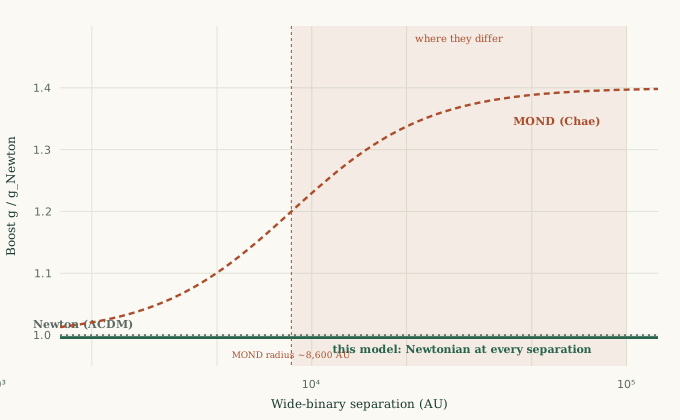
The model makes this quantitative. A Sun-like pair reaches its MOND radius near 8,600 AU, where plain MOND already predicts a 10–35% boost. This model predicts no boost at all, at any separation. Beyond 10,000 AU the pictures separate cleanly: Newtonian gravity and this model both give exactly 1, MOND gives 1.2 to 1.4. Gaia DR4 has the very wide binaries to measure it.
Honest
Where it fails.
The ultra-faint dwarf galaxies, Segue 1 above all, want a velocity dispersion a factor of 15 to 20 above what the model gives, a failure shared with every version of MOND. Clusters of galaxies keep their factor-of-two missing mass; the Bullet cluster and the cosmic microwave background are not addressed without a relativistic completion. These are inherited from MOND and are not repaired here.